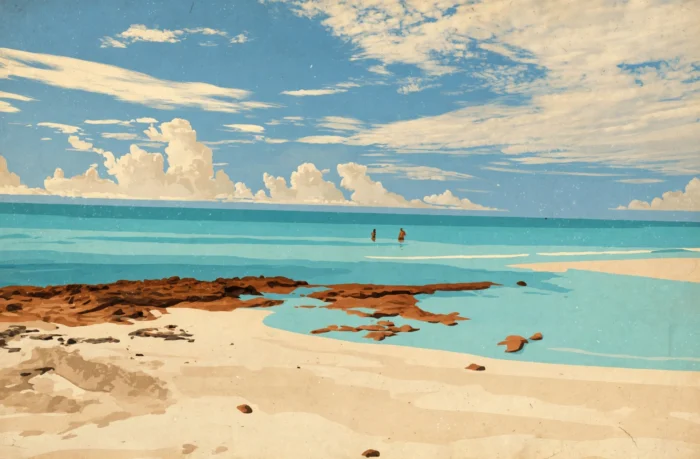

If you visited Tulum before 2024, you remember how the north beach worked: you drove or cycled up the beach road past the ruins turnoff, parked in a small lot, and walked onto Playa Paraíso. That road is gone as a public route. The whole north end — the ruins, the national park and the beaches from Santa Fe down to the start of the hotel zone — now sits inside Parque del Jaguar, a 2,913-hectare federal park that opened in 2024.
The park had a rough start. For a while, beach-goers were charged stacked fees at the gate just to reach the sand, and locals pushed back hard. That fight is largely won: since late 2025 the pedestrian and bike accesses have been open and free, and since July 2026 the beach itself is officially free for everyone. What you need now is not money — it’s a plan. Here’s how the north beach works today.
What the park is
Parque del Jaguar bundles four things into one managed destination:
- The Tulum archaeological zone, run by INAH — El Castillo and the cliff-top ruins.
- Parque Nacional Tulum, the protected coastal area administered by CONANP.
- The north beaches — Santa Fe, Pescadores, Maya/Paraíso and del Mangle.
- New visitor infrastructure built under the Tren Maya programme: the MURECO museum, a cultural lighthouse (El Faro), lookout towers, mangrove trails and a bike path.
The park gates are operated by GAFSACOMM (branded Grupo Maya), the state company that also runs the Tren Maya hotels and the Tulum airport. INAH runs the ruins and the museum; CONANP looks after the protected area. Three agencies, one fence — which is why the information online is such a mess.
What’s inside, beyond the beach
- MURECO — Museo Regional de la Costa Oriental. The regional museum inside the CATVI visitor centre at the north access: three permanent exhibition rooms plus a temporary gallery, covering the Maya coast’s history. Worth an hour, especially combined with the ruins. Open roughly 9 AM–5 PM.
- El Faro cultural. A cultural lighthouse near the ruins, with viewpoints around it.
- Miradores. Four named lookouts: Ka’an (a 360° view from 25 m up), Sac’be (a balcony facing the Caribbean and Playa Santa Fe), Hunab Ku (the sunset spot) and Kinich Ahau (jungle, coast and hotel-zone views). The beach viewpoints, mangrove trails and lookout tower are free spaces.
- Bike paths. A 1.1 km ciclovía inside the park, plus newly paved, low-traffic park roads.
- FONART artisan shop and a traditional smoke kitchen inside the park.
The beaches
Playa Santa Fe
The wide, quiet one at the north end. Confirmed free public access, few services — bring water and shade. This is the beach for people who found the hotel zone too much.
Playa Pescadores
The working fishermen’s beach. Boats on the sand, and the departure point for reef and snorkel boat tours. Lively in the morning when the boats go out.
Playa Maya / Playa Paraíso
The postcard beach just south of the ruins — the one in every photo of Tulum. “Playa Maya” is the name on the free public access; most people know the same stretch as Paraíso. Beach clubs on it rent loungers and charge minimum spends, but the sand itself is free.
Playa del Mangle
The southernmost of the confirmed free beaches, mangrove-backed and usually the emptiest of the four.
Playa Ruinas
The small beach directly below El Castillo. You reach it from inside the archaeological zone, down the stairs — so it needs the ruins ticket, and the stairs sometimes close for turtle nesting or surf. Beautiful, but it’s a ruins add-on, not a public-access beach.
The fees, explained honestly
This is where most guides get it wrong, so here it is plainly:
Beach and park entry is free. In July 2026 the President, the Governor of Quintana Roo and the federal Tourism Secretary all announced the same thing: access to Parque del Jaguar and its beaches is completely free for everyone, Mexican or foreign. On-the-ground reporting since then confirms it — you do not buy a park ticket to reach the sand.
The only ticket is the ruins. If you enter the archaeological zone, you pay the INAH charge — 80 MXN for Mexican nationals, 265 MXN for foreigners, as announced in July 2026. Tulum residents enter free with ID, and Mexican nationals get the ruins free on Sundays. The usual legal exemptions (seniors, students, teachers, people with disabilities, and others) apply with official ID.
Why do some guides still quote a park fee? Because a federal decree published on paper in July 2026 lists a 100-peso park tariff for foreigners, and plenty of sites — including some hotel pages still showing prices from 2025 — copied the paperwork instead of the practice. The decree is why you’ll see “265” broken down two different ways online. What visitors actually pay at the gate for the beach is nothing; the 265 figure is the ruins ticket for foreigners.
One caution: fees and gate practice here have changed three times in two years. If a gate attendant asks you to pay for beach-only entry, that’s out of line with the announced policy — but rules on the ground can lag announcements, so carry small cash and your ID just in case.
The three gates
Acceso Norte (CATVI)
By the Tulum Tren Maya station and the visitor centre that houses MURECO. Best if you’re combining the museum and ruins, or arriving by train.
Acceso Tradicional (Centro)
On Highway 307 at the ruins glorieta — the old entrance, and the one locals fought to reopen. It was re-enabled for free beach access in November 2025. The government has announced the existing wall will be replaced by an arch; no timeline has been published.
Acceso Sur
Via Avenida Cobá and the coastal road, at the start of the hotel zone. This is the gate the hotels and beach clubs inside the park direct their guests to. An ecological parking lot at the south access was announced in July 2026 but wasn’t built yet at last check — don’t count on it.
Through these three gates, Sectur counts eight beach accesses.
Getting to the sand: every option
Walk or bike in — free
Since November 2025, the Tradicional and Sur accesses are open to pedestrians and cyclists, 365 days a year, with signed routes. From the gate it’s about 2 km to the sand — a 25-minute walk, or an easy ride; bikes can go right in and lock up at the beach.
From town, the ride is about 4 km (20–35 minutes), with a bike path most of the way. Bikes can also be rented at the park (around 150 pesos a day at last report — prices here change, so treat that as a guide), and town rentals run roughly 150–300 pesos a day. More on getting around in our Tulum transportation guide.
The electric shuttle
Optional electric carts run inside the park, roughly 8 AM–5 PM. The officially announced price since July 2026 is 20 pesos per adult, 10 per child. Handy for the 2 km if you’re carrying kids, a cooler and a beach umbrella in midday heat.
Colectivo or taxi to the gate
Colectivos running Highway 307 will drop you at the ruins/park entrance — ask for “las Ruinas.” Fares from Centro are quoted anywhere from 20 to 80 pesos depending on the source; it’s cash only and cheap either way. Taxis and rideshares drop at the gates too; from there you walk, bike or take the cart.
By car — the catch
There is no public parking inside the park and no drive-in beach access. Private cars enter only with a confirmed reservation at a hotel, beach club or restaurant inside the park — you show the reservation at the gate and park at the venue. Everyone else leaves the car in private lots outside the gates, which charge by the day at varying rates. If you’re driving and just want the beach, honestly: park in town and bike in, or take a taxi to the Sur gate.
Rules inside the park
Bags and coolers are checked at the gates. Leave these at home:
- Single-use plastic and PET bottles — bring a reusable bottle.
- Glass bottles and styrofoam.
- Alcohol — you can’t bring it in; drinks are sold by authorised places inside.
- Cigarettes — no smoking.
- Speakers — no amplified music, which is a big part of why these beaches stay quiet.
- Drones.
- Pets — not allowed, for wildlife protection.
On sunscreen: park signage tells visitors to leave regular sunscreen behind to protect the reef and fauna. The workable reading — and what we do — is to use only reef-safe, biodegradable sunscreen, applied before you arrive, not in the water or on the sand.
You can bring food in reusable containers, coolers (no plastic or glass), and beach umbrellas.
Hours
The ruins keep the firmest hours: 8 AM–5 PM, last entry 3:30 PM, daily. The park gates were announced as 6 AM–7 PM in the July 2026 changes (older official information said 8 AM opening — if you’re planning a dawn arrival, the early opening is recent enough that we’d double-check at the gate). The beaches are a daytime proposition — plan on roughly 8 AM to 5–6 PM, and note the internal carts stop around 5 PM.
The short version
Bike in through the Tradicional or Sur gate, pay nothing, lock up at Santa Fe or Paraíso, and add the ruins only if you want them — that’s the north beach in 2026. It took a fence, a fee fight and a highway blockade to get here, but the result is the quietest, prettiest stretch of public beach in Tulum, finally open the way it should be.

Author: Ron Burdine
From the Colorado mountains to the Mexican Caribbean! I have been living in Tulum, Mexico since 2007. Over the years I have explored and discovered many beautiful places, special events, activities and dining experiences. I love sharing these special locations, occasions and naturally sublime Tulum experiences! It has truly become my passion to help people get the most from their Tulum time experience. Everyone's Tulum dream includes highlights and a vision of an experience. I love making these connections.